OPC UA Aggregator
Hundreds of servers. One address space. One session.
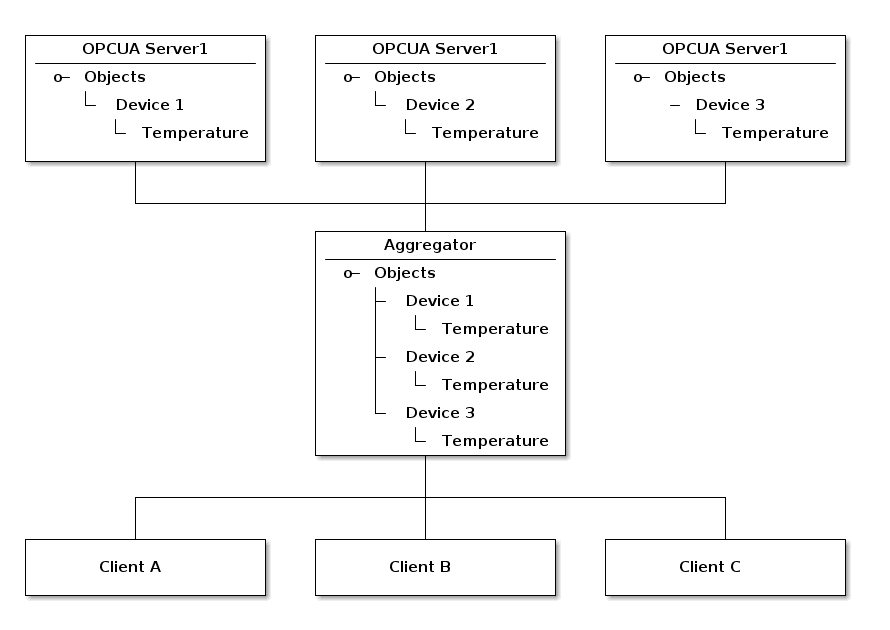
The NodeOPCUA Aggregator connects simultaneously to hundreds of OPC UA servers and merges them into a single unified tree — so your SCADA, historian or cloud client only ever opens one secure session and sees one consistent model. Built and supported by Sterfive, the authors of node-opcua.
By the maintainers of node-opcua
The aggregation problem we kept seeing — packaged.
"Every integrator who scales beyond a few dozen OPC UA servers hits the same wall: client tools, historians and cloud connectors weren't designed for fleets of hundreds. The natural answer is a fan-in aggregator that fronts the entire estate as one address space — and we kept building variations of it for customer after customer. The NodeOPCUA Aggregator productises that pattern: one configurable server, the full node-opcua stack underneath, and the engineers who wrote that stack on speed dial."
Etienne Rossignon — Creator of NodeOPCUA & CEO of Sterfive
One endpoint in front of the fleet
Anywhere a client tool was never designed to talk to hundreds of OPC UA servers, the Aggregator becomes the single secure session in front of them. The fleet stays heterogeneous; the consumer sees one tree.SCADA & Historian Fan-In
One session, hundreds of upstream servers
Most SCADA and historian products license per session or struggle past a few dozen connections. Put the Aggregator in front of the fleet and they only ever see one session — to one server — exposing the merged address space of every upstream node. Connection cost drops, dashboards become responsive, licensing terms get easier.
Cloud & MES Ingestion
A clean north-bound endpoint
Cloud connectors and MES platforms prefer one well-defined endpoint to manage and authenticate against. The Aggregator gives them exactly that — one OPC UA server with the entire plant's address space behind it — while the heterogeneous fleet (mix of vendors, mix of firmwares) stays untouched.
Multi-Site Consolidation
Several plants, one OPC UA window
Run an Aggregator at the corporate OT/IT boundary, point it at each plant's local OPC UA infrastructure, and you have a single unified view across sites — with namespace remapping to keep names unique and a single PKI trust list to maintain.
Filtering & Re-Exposure
Trim, rename, secure — then expose
Not every variable from every upstream server needs to be visible downstream. The Aggregator filters branches, remaps namespaces and re-exposes only the curated subset — useful for security boundaries, third-party integration and tiered data-access policies.
A production-grade fan-in, not a hobby project
Built on the same node-opcua stack we maintain upstream, hardened for industrial scale, supported as a commercial product with direct access to the maintainers.
- Massive fan-in
Concurrent connections to hundreds of upstream OPC UA servers, merged into a single, navigable address space. Tested at industrial scale.
- Namespace remapping
Avoid collisions when two upstream servers use the same browse names. Configure namespace aliases per upstream so downstream clients see a clean, unambiguous tree.
- Selective re-exposure
Whitelist or blacklist branches from each upstream — useful for security boundaries, tiered data exposure, or simply hiding upstream clutter from downstream clients.
- Secure single endpoint
Downstream clients see one OPC UA server: one session, one cert, one set of user roles, one audit trail. Upstream credentials and certificates stay inside the Aggregator.
- Resilient upstream connections
Automatic reconnection, per-upstream timeouts, transparent recovery when individual servers come and go. One flaky PLC does not destabilise the rest of the fleet.
- Backed by node-opcua's authors
Built on the same
node-opcuastack Sterfive maintains upstream. Direct access to the maintainers is included with every paid tier — no dependency chain.
Ready to consolidate your OPC UA fleet?
Hundreds of servers, one session
Request a quote, ask for an evaluation licence, or get a live demo of the Aggregator running in front of a real multi-vendor estate. Direct maintainer access is included with every paid tier — a benefit unique to buying from the team that authors the underlying OPC UA stack.
The Sterfive Aggregator is distributed under a commercial licence; the source code can be made available under a separate engineering agreement.